Printed signage has a cost that most hotels underestimate. It is not just the printing itself, but the labor, the delays, the outdated information and the missed revenue from promotions that never reached guests.
This article breaks down the real cost comparison between printed and digital signage for a full-service hotel, using data from Logical Signage client properties and industry benchmarks.
What printed signage actually costs
Most hotels track printing as a single line item, but the real cost of printed signage includes several components that are rarely measured together:
- Design and production: graphic design fees, file preparation and artwork revisions for each update
- Printing: per-unit cost for event boards, directional signs, menus, promotional materials and room cards
- Distribution labor: staff time to physically place, replace and remove printed materials across the property
- Waste: materials that become outdated before they're used, or are reprinted due to last-minute changes
- Opportunity cost: promotions and services that weren't communicated because reprinting was too slow or too expensive
Printed signage: typical full-service hotel
- Event directional boards: $600/mo
- Meeting room signage: $400/mo
- F&B and promo materials: $700/mo
- Lobby and wayfinding: $400/mo
- Distribution labor: $300/mo
Digital signage: same property
- Software license: $400/mo
- Content updates: included
- Real-time changes: included
- Distribution labor: $0
- Waste: $0
The hidden costs of printed signage
Beyond the direct printing budget, there are operational costs that rarely appear in a line item but are very real:
Last-minute changes
When an event room changes at 7am, someone has to reprint directional signs, walk the property, remove old signage and place new signage before attendees arrive. That process takes 30–60 minutes of staff time per incident. In a convention hotel running multiple events daily, this adds up to several hours of labor per week dedicated entirely to signage corrections.
Outdated information
Printed signage showing yesterday's events, expired promotions or incorrect schedules actively creates a negative guest experience. The cost of guest confusion (additional front desk inquiries, negative reviews, reduced satisfaction scores) is harder to quantify but real.
Missed revenue opportunities
A spa promotion that costs $200 to design and print, but only reaches guests who happen to walk past it, has a much lower ROI than a digital screen that rotates the same promotion to every guest passing through the lobby, elevator and corridor. The reach differential is significant.
What digital signage costs
Digital signage has three cost components:
- Hardware: screens, media players and mounting. One-time cost, typically depreciated over 7 years. For a 20-screen deployment, hardware typically runs $15,000–$40,000 depending on screen size and quality.
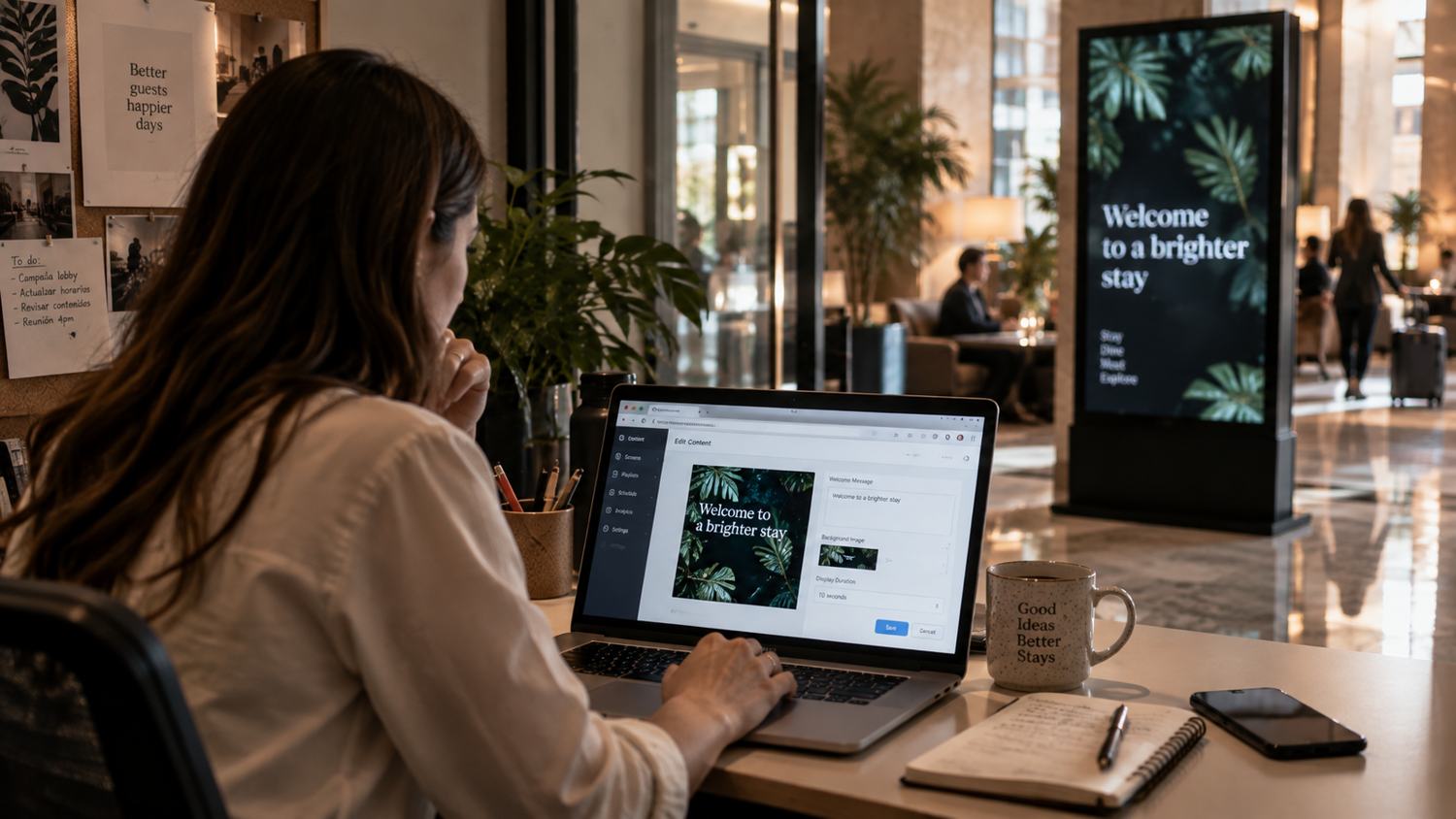
- Software license: the CMS platform and integrations. Typically $300–$600/month for a full-service hotel deployment.
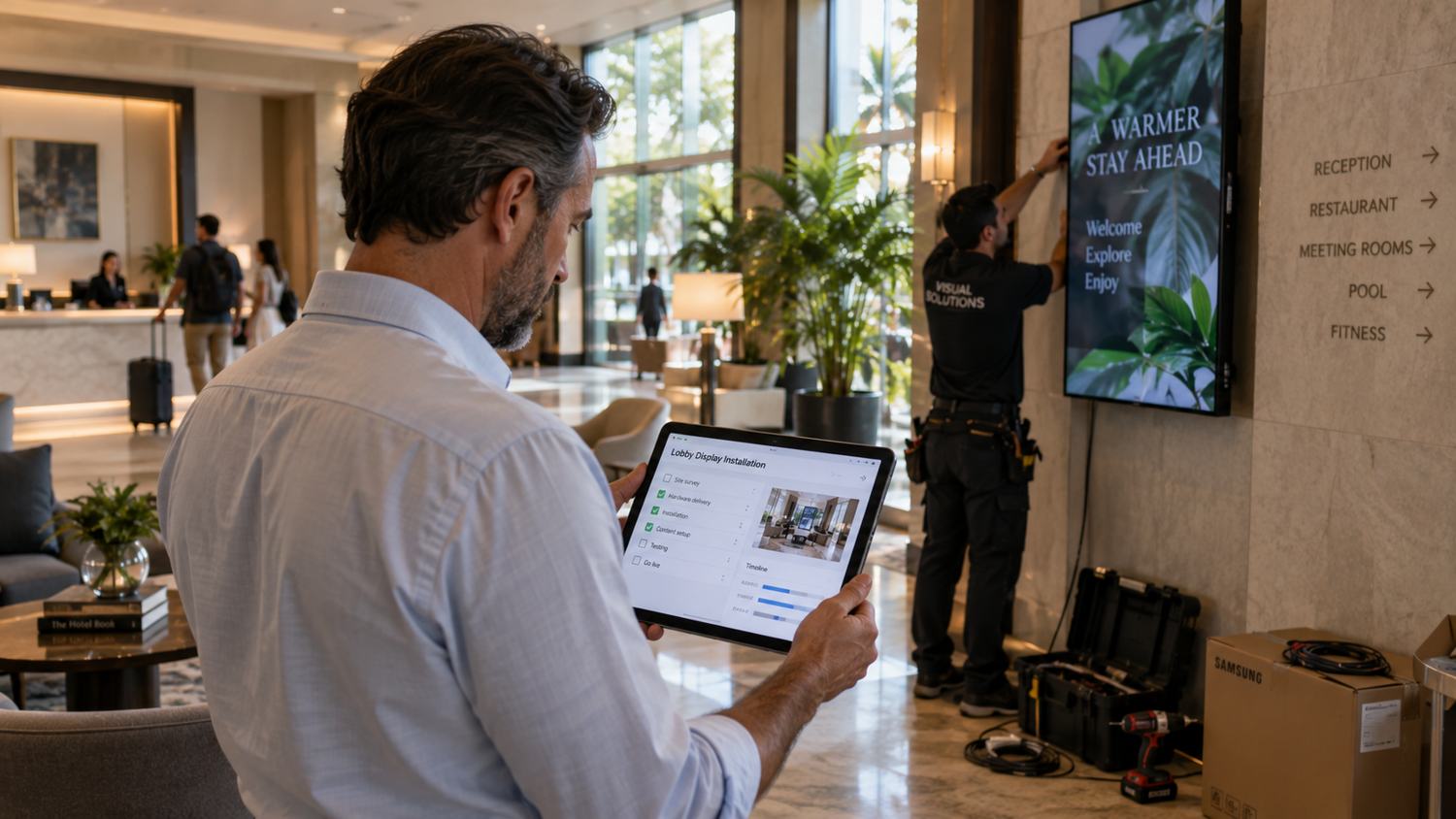
- Implementation: installation, configuration and training. One-time cost, typically $5,000–$15,000 depending on property complexity.
After year one, the ongoing cost is the software license only. There are no per-update costs, no design fees for routine content changes and no distribution labor.
Side-by-side comparison
| Cost factor | Printed signage | Digital signage |
|---|---|---|
| Per-update cost | $50–$300 per update | $0, included |
| Last-minute changes | 30–60 min labor each | Seconds, automatic |
| Waste from outdated materials | High, reprints frequent | Zero |
| Distribution labor | Several hrs/week | Zero |
| Upfront cost | Low | Medium–High (hardware) |
| 7-year total cost | High, recurring forever | Lower after year 2–3 |
| Revenue visibility | Static, limited reach | Dynamic, full property |
When does digital signage break even?
For a typical full-service hotel spending $2,000–$3,000/month on printed signage and related labor, digital signage typically reaches break-even within 18–30 months of deployment, depending on hardware investment and current print spend.
Hotels with high event volume, such as convention centers and conference hotels, typically see faster break-even because the operational savings from eliminating last-minute print runs are higher.
For ownership groups evaluating the investment, the 7-year total cost of ownership for digital signage is consistently lower than the equivalent period of print spend, once hardware is amortized.